
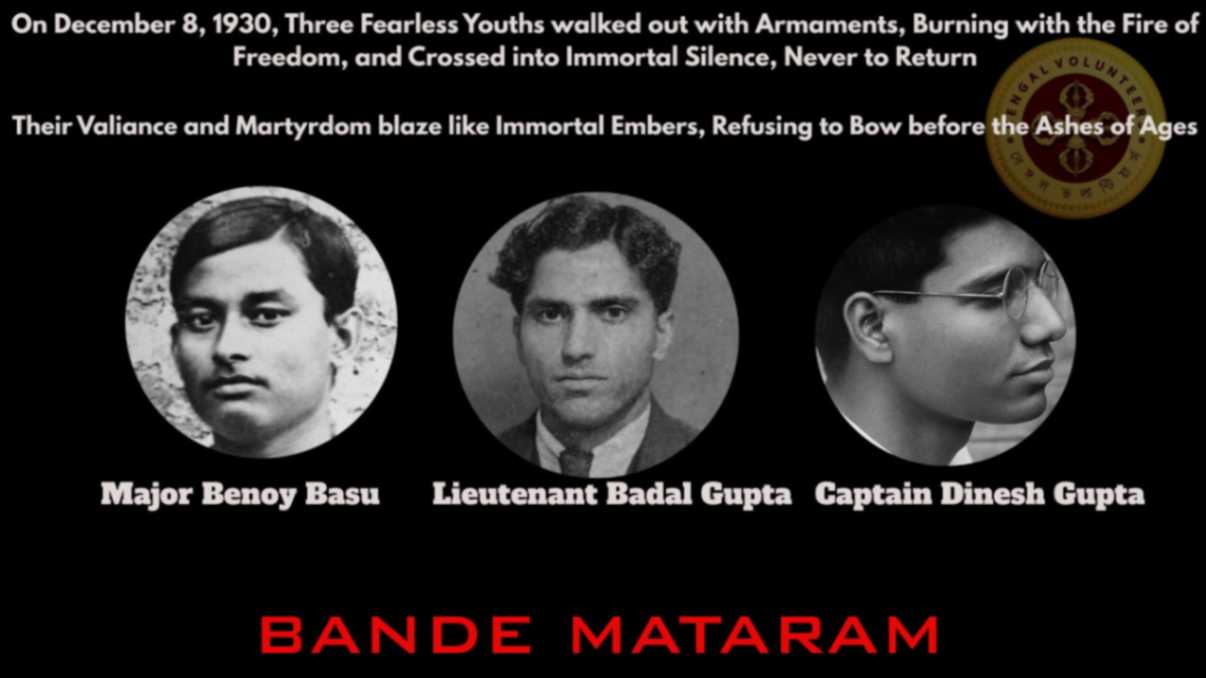
On December 8, 1930, the landscape of Indian revolutionary history was indelibly marked by the heroic and unforgettable sacrifice of three fearlessly committed Bengal Volunteers revolutionaries—Major Benoy Bose, Lieutenant Badal Gupta, and Captain Dinesh Gupta. Their valiant struggle against British colonial oppression ignited the spirit of resistance across Bengal and beyond, embodying the undying flame of freedom in the face of brutal imperial power. These brave souls were not merely insurgents but fervent patriots who embraced martyrdom with iron resolve, ready to lay down their lives for the cause of India’s liberation.
The Bengal Volunteers, a revolutionary organization known for their relentless dedication and courage, were at the forefront of challenging British supremacy. With strategic precision and a unity fueled by patriotic fervor, the Bengal Volunteers revolutionaries boldly attacked the British establishment’s symbols of authority, disrupting the colonial regime and instilling fear among their oppressors.
The fortitude of these revolutionary Bengali Hindus during this turbulent era reflected an unwavering commitment to the idea of a free India, one that transcended personal safety or comfort. The Bengal Volunteers formed a disciplined cadre that combined calculated militancy with deep ideological conviction, operating amidst a landscape marked by widespread socio-political unrest. They sought to inspire ordinary Indians to embrace revolutionary ideals and stand defiant against colonial forces. December 8, 1930, famously known for the attack on the Writers’ Building in Kolkata, saw Major Benoy Bose, Lieutenant Badal Gupta, and Captain Dinesh Gupta strike at the nerve center of British administration in Bengal.
Their assault targeted the Inspector General of Police – Lt Col NS Simpson, a brutal enforcer of colonial rule, symbolizing the broader oppression that Indians endured under the Raj. What made their actions even more striking was not just the daring attack but the courageous choice to face death rather than surrender—a testimony to their resolve and sacrifice that would resonate through generations.
The immortal courage exhibited by these Bengal Volunteers revolutionaries intertwined closely with the vision and leadership of Sri Subhas Chandra Bose, famously known as Netaji. Although Netaji later became globally renowned for his role in the Indian National Army, his relationship with the Bengal Volunteers was rooted in mutual respect, shared ideals, and a collaborative revolutionary spirit. Subhas Chandra Bose, through his charismatic leadership, inspired and encouraged the Bengal Volunteers to maintain an uncompromising stance against British imperialism. His ideology of militant nationalism found fertile ground among these young revolutionaries, who admired his emphasis on sacrifice, self-discipline, and absolute dedication to the nation’s cause. The Bengal Volunteers not only undertook daring revolutionary activities but also served as a living example of political activism that combined fearless action with visionary leadership. Netaji’s connection to this group was instrumental in galvanizing the revolutionary movement in Bengal, a region that was both a hotbed of nationalist fervor and strategic resistance.
Beyond the legendary martyrdom of Benoy, Badal, and Dinesh, the Bengal Volunteers carried out multiple revolutionary activities that deeply unsettled the British colonial government. Their operations ranged from targeted assassinations of oppressive officials, sabotage, mobilization of youth for rebellion, and dissemination of revolutionary ideologies through underground networks. These activities demonstrated their strategic acumen and unwavering commitment to destabilizing British control, making the Bengal Volunteers a significant thorn in the side of the Raj. The British authorities were well aware that these revolutionaries were not isolated actors but part of a larger, organized movement with deep grassroots support and ideological resilience. The British administration’s increasing alarm led to intensified policing, crackdowns, and draconian laws aimed at dismantling the revolutionary infrastructure, yet the Bengal Volunteers persisted undeterred.
The fear that the Bengal Volunteers inspired among the British Raj was palpable and well justified. The revolutionaries’ ability to mobilize the youth and their success in striking key colonial officials epitomized a direct challenge to British authority. Their epitomic attack in the Writers’ Building shattered any illusion of British invincibility and highlighted the vulnerabilities of colonial governance in India’s urban centers. The British feared the ripple effects that such acts of defiance could have in fomenting wider rebellion across the country. Consequently, the Bengal Volunteers were viewed not just as rebels but as a formidable insurgency threat demanding urgent containment. This fear drove the Raj to heighten political repression, yet the revolutionary spirit that the Bengal Volunteers embodied could not be crushed. Their legacy fueled ongoing resistance, inspiring future generations of freedom fighters.
The story of Major Benoy Bose, Lieutenant Badal Gupta, and Captain Dinesh Gupta on December 8, 1930, remains a testament to the supreme sacrifice and unyielding courage of the Bengal Volunteers. This trio’s ultimate act of defiance saw them opting for self-inflicted death inside the British police premises rather than surrender, an act symbolic of their staunch refusal to submit. Their martyrdom immortalized the Bengal Volunteers as icons of nationalism and valor, etching their names into the annals of India’s freedom struggle.
The bravery demonstrated by these revolutionary Bengali Hindus not only momentarily shook the British Raj but also permanently enriched the narrative of India’s fight for independence. Their legacy, intertwined with the leadership ideals of Sri Subhas Chandra Bose, continues to inspire the spirit of patriotism and resistance in India. Through their unrelenting commitment, the Bengal Volunteers proved that the flame of revolution could burn brightly even in the darkest of times, and that courage coupled with conviction can indeed pave the way to liberation.
Benoy, the leader, fierce as lightning’s crash, Bold Badal, with a rebel’s brash, Dinesh, the captain, steady in the night, Together weaving freedom’s fierce light.

শ্রী অনিমিত্র চক্রবর্তী হলেন একজন সাংবাদিক ও বিভাগীয় লেখক (columnist) এবং বেঙ্গল ভলান্টিয়ার্সের এক সক্রিয় কর্মী।