
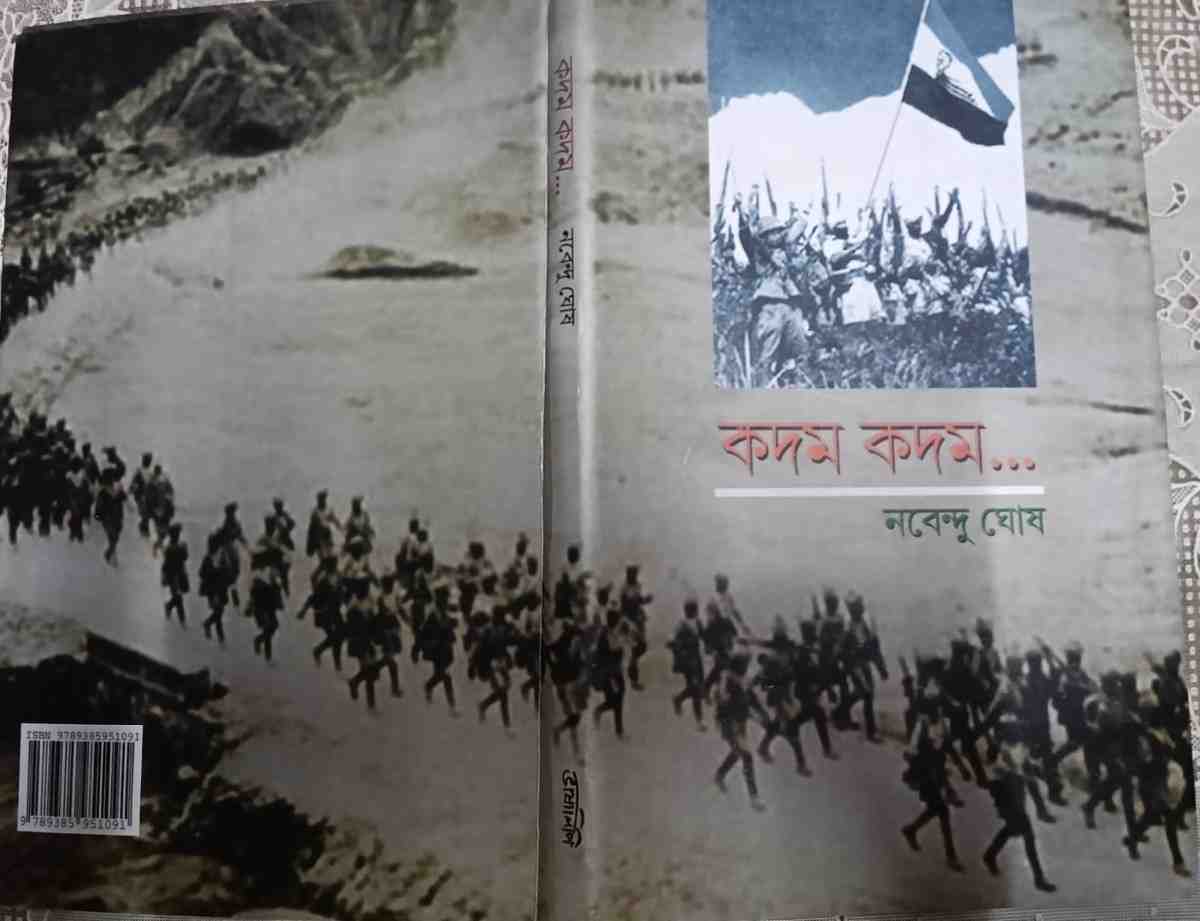
 Literature often becomes the bridge between history and the human soul, and “Kadam Kadam-The Long March” stands as a glowing example of that rare union. This Bengali work, the final novel by the celebrated writer Nabendu Ghosh, revisits one of the most turbulent phases of the twentieth century through the extraordinary journey of actor Nazir Hussain. Set against the dramatic backdrop of the Second World War and the rise of the Indian National Army, the book is not merely a war narrative but a deeply emotional exploration of transformation, conviction, and identity shaped by the magnetic influence of Netaji Subhash Chandra Bose.
At the heart of the story is Nazir Hussain, remembered by many as a well known face in Indian cinema, yet here revealed in a lesser known but remarkable chapter of his life. The novel traces how a man associated with performance and storytelling in the arts was drawn into the storm of history. While in Singapore during the war years, Hussain came under the spell of Netaji’s powerful vision of freedom. The call of the Indian National Army was not political rhetoric for him but a deeply personal awakening. The disciplined march of soldiers, the electrifying speeches, and the shared dream of liberation ignited in him a sense of purpose that redefined his life. His journey from the world of lights and stage to the hardships of a soldier becomes a metaphor for inner awakening.
Nabendu Ghosh handles this transformation with the sensitivity of a master storyteller who understands the fragility of human emotions. He does not turn Hussain into a distant heroic statue. Instead, he portrays his doubts, fears, and emotional conflicts. The war is present not only in the battlefield scenes but in the silent struggles of the mind. The pull between art and duty, personal safety and national cause, memory and hope gives the narrative a layered richness. Through Hussain’s eyes, readers witness the atmosphere of exile, longing, and determination that surrounded the Indian National Army in Southeast Asia.
This novel also carries the unmistakable literary stamp of Nabendu Ghosh’s worldview. Ghosh was not merely a novelist but a chronicler of upheaval. His writings across decades captured famine, communal tension, partition, and the everyday endurance of ordinary people. In Kadam Kadam The Long March, that same compassionate gaze turns toward the psychological cost of war and displacement. His prose often feels like it is pointing a quiet but firm finger at injustice, indifference, and the tragic ironies of history. Yet it never loses tenderness. Even in scenes of suffering, there is a belief in the resilience of the human spirit.
Ghosh’s ability to weave symbolism and subtle meaning is evident throughout the novel. The march itself becomes more than a military movement. It suggests the long journey of a nation toward self realization, and the inner march of an individual toward moral clarity. Small details carry emotional weight. A shared meal among soldiers, a remembered melody, or a fleeting thought of home becomes charged with longing. These moments reveal Ghosh’s deep empathy for human emotion, an empathy that defined his entire body of work.
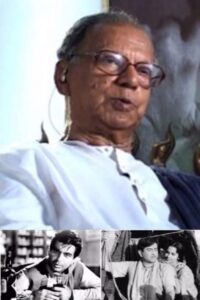
The significance of this book also lies in its place within the author’s remarkable career. Nabendu Ghosh earned legendary recognition as a screenplay writer for iconic filmmakers of Mumbai in the nineteen fifties, sixties, and seventies. His collaborations brought literary depth to Indian cinema during a golden era. Films shaped by his writing were known for realism, emotional complexity, and social awareness. Yet he remained equally committed to literature, producing twenty six novels and fourteen short story collections. His creative life moved fluidly between page and screen, always rooted in human experience.
His directorial venture Trishagni, released in nineteen eighty eight and based on a historical short story by Saradindu Bandopadhyay, further demonstrated his ability to translate layered literary themes into visual form. That background in cinema enriches Kadam Kadam The Long March. The narrative often unfolds with a visual intensity. Scenes feel carefully framed, characters move with dramatic presence, and emotional climaxes arrive with the quiet power of a well crafted film sequence. Readers can almost see the tropical landscapes of wartime Singapore and the tense gatherings of INA volunteers.
Another deeply personal dimension of the book is its translation by Ratnottama Sengupta, Ghosh’s daughter. Her work ensures that the emotional rhythms and cultural nuances of the original Bengali text reach a wider audience. This familial connection adds a layer of continuity, as if the legacy of memory and storytelling passes from one generation to the next. The translation does not feel mechanical. It carries the warmth of someone who understands both the writer and the world he created.
Ultimately, “Kadam Kadam-The Long March” is a story about love in its broadest sense. Love for freedom, love for humanity, love for dignity in the face of suffering. Even amid the harshness of war, Ghosh’s belief in human connection shines through. His characters are flawed yet compassionate, shaped by circumstance yet capable of choice. The novel reminds readers that history is not only made by grand leaders but also by individuals who respond to a call that touches their conscience.
As the final novel of a towering literary figure, the book feels like a culmination of themes that ran through Nabendu Ghosh’s life work. It unites history, emotion, symbolism, and moral inquiry into a moving narrative. Through the life of Nazir Hussain and the shadow of Netaji’s vision, the novel preserves a chapter of the freedom struggle while also exploring the timeless question of how a person discovers purpose. In doing so, it leaves readers with a sense of both sorrow and inspiration, echoing the steady rhythm of a march that continues long after the last page is turned.

শ্রী অনিমিত্র চক্রবর্তী হলেন একজন সাংবাদিক ও বিভাগীয় লেখক (columnist) এবং বেঙ্গল ভলান্টিয়ার্সের এক সক্রিয় কর্মী।