
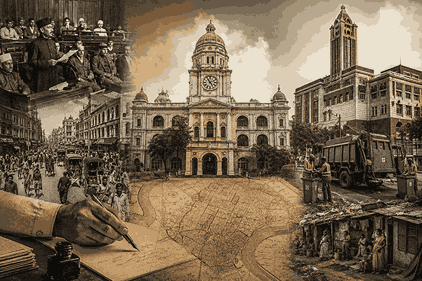
Modern Kolkata often presents itself as a city shaped by Renaissance thinkers, nationalist movements, trade unions, literary giants, and post-Independence politics. Yet beneath the visible layers of contemporary civic administration lies an older institutional inheritance — one forged during the turbulent decades of late colonial Bengal. Among the most overlooked influences on Kolkata’s municipal structure is the political legacy of the Muslim League and the Bengal ministries of the 1930s and 1940s.
While the present-day Kolkata Municipal Corporation (KMC) operates under the Kolkata Municipal Corporation Act of 1980, many of its administrative foundations trace their origins to earlier municipal laws, especially the Calcutta Municipal Act of 1923 and its subsequent amendments during the pre-Partition era. Several of those amendments emerged at a time when Bengal’s politics had become deeply shaped by communal representation, demographic anxieties, and the growing influence of the Muslim League in provincial governance.
This historical continuity does not mean that the current KMC is a “Muslim League institution.” The communal electoral structures introduced before Independence were abolished long ago. However, many administrative mechanisms, territorial practices, and governance frameworks that were revised or strengthened during Muslim League influence in Bengal survived the transition from colonial Calcutta to modern Kolkata.
The most enduring example is the ward-based structure of municipal representation. Today, Kolkata is divided into wards represented by elected councillors. This appears routine to modern citizens, but in the late colonial period, ward boundaries were intensely political. During the 1930s and 1940s, debates over municipal wards became tied to questions of religious demography and political influence. Muslim League leaders argued that Muslims in Calcutta were underrepresented in civic institutions despite rising population numbers in several areas of the city.
As a result, municipal restructuring became a political battleground. Changes in ward distribution, seat allocation, and electoral arrangements were not merely technical reforms; they reflected larger contests over power in Bengal’s capital. Although separate communal electorates disappeared after Independence, the territorial logic of ward-centric urban politics survived and remains central to Kolkata’s civic administration today.
Another major continuity lies in municipal taxation and property assessment. The KMC’s present system of annual valuation, assessment books, holding records, and property taxation evolved from colonial municipal finance structures that were consolidated during the late British period. The administrative language itself — terms such as “annual value,” “assessment,” and “municipal holding” — reflects that continuity.
During the pre-Partition decades, Calcutta’s expanding population and industrial economy made municipal revenue increasingly important. Successive Bengal governments, including ministries supported by the Muslim League, relied heavily on these taxation mechanisms to manage urban services. Though revised repeatedly after 1947, the underlying framework remains recognizable even in today’s KMC administration.
The persistence of the term “bustee” within municipal law is another striking reminder of colonial-era governance. In Kolkata, the word refers to densely populated informal settlements or slum areas. The legal recognition and administrative categorization of bustees developed under British municipal policy, particularly during periods of rapid urban migration and industrial expansion.
By the 1930s and 1940s, bustee management had become a major civic concern because of overcrowding, sanitation problems, labor migration, and recurring epidemics. Municipal laws from that era created regulatory structures for these neighborhoods, many of which continued into post-Independence legislation. Even today, the word “bustee” survives in legal and administrative usage within Kolkata’s civic framework.
Building regulations also reveal strong institutional continuity. Modern KMC rules concerning drainage, street alignment, dangerous buildings, sanitation standards, warehouse classifications, and construction permissions owe much to the municipal codes refined during late colonial governance. Calcutta’s rapid expansion before Independence forced administrators to develop extensive regulatory systems to control congestion and maintain basic urban infrastructure.
These laws were shaped not only by engineering concerns but also by the political realities of the time. Different communities often occupied distinct urban zones, and municipal regulation frequently intersected with demographic and electoral politics. In this environment, civic administration became inseparable from broader struggles over representation and control.
Another surviving feature is the concept of decentralized borough-style administration. Although modern borough committees differ from their colonial predecessors, the basic idea of subdividing the city into manageable administrative units emerged during the evolution of Calcutta’s municipal system before Independence. The Muslim League era did not invent decentralization, but it operated within and reinforced that framework during a critical phase of institutional development.
Perhaps the most subtle legacy is political rather than legal. The municipal politics of Kolkata still revolve heavily around neighborhood identity, demographic concentration, and territorial voting patterns. This culture of localized electoral competition has deep roots in the communalized urban politics of the late colonial period.
Before Partition, municipal debates often mirrored wider provincial tensions between Hindus and Muslims in Bengal. Questions of representation inside the Calcutta Corporation became symbolic of larger political anxieties. While modern Kolkata operates under India’s secular constitutional order, the style of intensely localized ward politics remains one of the enduring inheritances of that earlier era.
At the same time, it is important to avoid oversimplification. The present Kolkata Municipal Corporation is the product of many historical layers — British colonial administration, nationalist reforms, post-Independence legislation, Left Front restructuring, and contemporary urban governance. The Muslim League’s influence formed only one chapter within that longer institutional history.
Yet history often survives not through slogans or monuments, but through systems. Laws outlive governments. Administrative structures persist long after the ideologies that shaped them fade away. In Kolkata’s case, several features of modern municipal governance still carry the imprint of political battles fought in pre-Partition Bengal nearly a century ago.
The result is a fascinating paradox: even in twenty-first century Kolkata, fragments of late colonial and Muslim League-era governance continue to exist quietly within the legal architecture of the city’s civic administration.

শ্রী অনিমিত্র চক্রবর্তী হলেন একজন সাংবাদিক ও বিভাগীয় লেখক (columnist) এবং বেঙ্গল ভলান্টিয়ার্সের এক সক্রিয় কর্মী।