
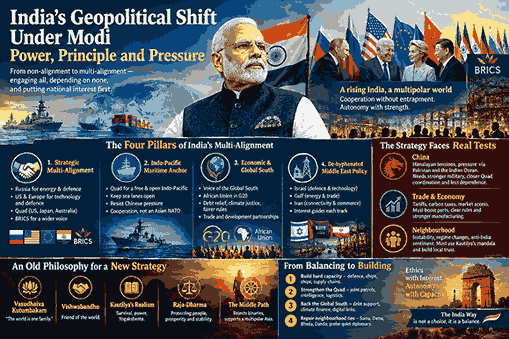
India’s foreign policy has changed clearly under the Hon’ble Indian Prime Minister Sri Narendra Modi because non-alignment has faded and multi-alignment has replaced it. The logic is straightforward: engage all major powers, depend on none, and protect national interest first. In a divided world, this has made India a swing power and a net security provider. It rejects control by one or two powers and seeks many centres of influence. This shift shows both confidence and concern, as India is rising yet still faces serious security and economic risks.
From Non-Alignment to Multi-Alignment
This direction rests on four linked pillars, beginning with strategic multi-alignment. India still buys oil and arms from Russia while building defence and technology ties with the United States and Europe. The West finds this dual track confusing, but New Delhi sees it as common sense because energy and defence needs are urgent. There is no reason to lose one partner merely to please another, so India keeps both doors open. It joins Quad meetings and BRICS summits alike and thus refuses any binary choice.
The second pillar follows logically, because managing rivals needs a maritime anchor in the Indo-Pacific. India works with the United States, Japan and Australia through the Quad to keep sea lanes open and resist Chinese pressure. Yet it draws a clear limit and does not accept the Quad as an Asian NATO. It wants joint drills and shared data, but not a binding pact that would curb its freedom. The result is cooperation without entrapment.
The third and fourth pillars widen the same autonomy to economics and the Middle East. As the voice of the Global South, India brought the African Union into the G20 and backs debt relief, climate justice and fairer rules. This gives moral weight and bargaining power, since India claims to speak for much of humanity rather than alone. At the same time, de-hyphenated diplomacy keeps ties with Israel, Iran and the Gulf states separate from each other. India can therefore buy defence systems from Israel, import Gulf oil and sustain trade links through Iran, with interest guiding each track.
An Old Philosophy for a New Strategy
These moves look tactical, but Jaishankar links them to older Indian thought in The India Way and Why Bharat Matters. He argues that India follows its own civilisational logic rather than Western models, and this claim connects policy to philosophy.
The first strand is VasudhaivaKutumbakam, meaning the world is one family, drawn from the Maha Upanishad. Modi has invoked it at the UN, and it became India’s G20 theme of One Earth, One Family, One Future. It supports vaccine aid, disaster relief and climate action, and it projects India as a bridging power. Linked to it is Vishwabandhu, or friend of the world, which justifies flexible ties with rival capitals. India can therefore meet Washington one day and Moscow the next, treating both as friends and neither as an exclusive ally.
Behind this warmth lies Kautilyan realism from the Arthashastra, where Chanakya stressed survival, power and Yogakshema, or people’s welfare. MEA lectures still cite this text on alliances and neutrality, so the method is both idealist and hard-headed. VasudhaivaKutumbakam supplies the message while Kautilya guides the move. This blend is reinforced by Raja-Dharma, the ruler’s duty to protect his people, which India cites to defend discounted Russian oil for 1.4 billion citizens. Finally, the Middle Path from Buddhist thought rejects East-versus-West binaries and supports a multipolar Asia where no hegemon dictates terms.
Where the Strategy Struggles
The framework is coherent, but three linked problems expose its limits. China is the hardest test because Himalayan tensions persist while Beijing pressures India through Pakistan and the Indian Ocean. The Quad meets often, yet deterrence stays weak and multi-alignment has not fixed the border. India cannot remain Vishwabandhu toward a neighbour that claims its land, so it needs faster military upgrades, closer Quad coordination and lower dependence on China in key sectors.
Trade is the second test and closely tied to the first, since strategy without economic muscle stays hollow. The United States and European Union raise tariffs, impose carbon taxes and seek wider access to India, while New Delhi must defend growth and jobs. India thus preaches South-South unity but struggles to close fair deals with major economies. The fix must start at home with faster ports, clearer rules and stronger manufacturing.
The neighbourhood is the third test and shows the cost of global ambition without local trust. South Asia is unstable, regimes change fast and anti-India sentiment flares nearby, even as India seeks global height. Kautilya warned of this through the mandala, or circle of neighbours, since wider power fails when this circle breaks. India cannot guide the South while losing its own backyard.
From Balancing to Building
India must therefore move from balancing to building through four practical steps. First, it should fund hard capacity in defence, chips, ships and supply chains, because options alone do not create power. Second, it should sharpen the Quad with joint patrols, shared intelligence and common logistics, since Beijing respects action more than declarations. Third, it must back its Global South pitch with continued real debt support, climate finance and digital links, or leadership claims will sound hollow. Fourth, it should repair nearby ties by resorting to Chaturvidhopāya:“Sama, Dama (Dana), Bheda, Danda”on time and preferring quiet diplomacy over public pressure.
The Modi era has made India more assertive by blending VasudhaivaKutumbakam with Kautilya, or ethics with interest. Yet ideas alone cannot guard borders or grow markets, so autonomy needs capacity. To befriend all is useful, but to deter one known and potential rivals is vital, and that balance will decide if the India Way succeeds.
On Author –
Sri Binoy Halder is an Assistant Professor, Department of Political Science, Jamalpur Mahavidyalaya, Purba Bardhaman, W.B.